

HelloBiome has launched SLST — single locus sequence typing for Cutibacterium acnes — making the academic gold standard for profiling acne’s key bacteria available to brands for the first time. This article recaps the Microbiome Intelligence Live session where our CEO Elsa Jungman, Ph.D., and CSO Grace Park, Ph.D., discussed what it resolves and how to build a claim on it.
Nearly everyone carries a large amount of C. acnes, acne-prone or not. What separates healthy skin from acne-prone skin isn’t how much C. acnes is present — it’s which sub-type. That distinction is now something brands can test for directly, not just something academic papers have mapped.
For years, the most rigorous way to read the bacteria behind acne lived inside academic labs. We’re putting it in the hands of the brands who can use it. It raises the bar for what a microbiome claim can actually prove — and it’s a standard no one else in the industry offers.
During the session, Elsa and Grace walked through exactly what that resolution unlocks for acne and longevity claims — and how it fits into a study that’s already running.
We’ve turned their test-by-test breakdown into a downloadable comparison chart, so it’s easy to match the right test to the right claim.
It’s Not How Much C. Acnes — It’s Which Sub-Type
Skin microbiome claim substantiation usually starts with a shotgun or 16S/ITS sequencing run. But C. acnes doesn’t behave as a single organism. It behaves as several — and resolving which one is exactly what SLST was built to do.
- Public shotgun databases are built mostly from gut microbiome data and higher-profile pathogens like Staphylococcus aureus, not skin, and not C. acnes specifically.
- Reaching strain-level resolution through shotgun alone means manually isolating the relevant region — a slow, sequencing-intensive process.
As Dr. Grace Park put it in the press release announcing SLST:
Species-level data tells you how much C. acnes is on the skin, but almost everyone has a lot of it. The signal is in the sub-type. Being able to resolve it gives brands a far more specific, defensible foundation for the claims they make.
It replaces that cost and timeline with one purpose-built test that resolves C. acnes strains directly, making it faster and more cost effective for acne and longevity brands to subtantiate their claims. Let’s dive more into the science and detail we covered in our recent webinar and break down exactly what this new sequencing method has to offer.
What Phylotype-Level Data Adds to an Acne Claim
Resolving C. acnes at the strain level has been possible for years — just not commercially, and not for claims work, until now.
Single locus sequence typing (SLST) is the academic gold standard for that resolution; HelloBiome co-developed the commercial assay with its sequencing partner lab and validated it against its own historical acne shotgun data before bringing it into claims work.

SLST resolves C. acnes into six phylotypes: IA1, IA2, IB, IC, II, and III. Each one carries a different association with acne or healthy skin, and Dr. Grace Park singled out the one that matters most for acne claims:
IA1 really is the culprit, and recent in vitro research also shows that 1A1 is the pro-inflammatory C. acne strain, which could be causing the inflammation within acne.
That predominance of 1A1, and the loss of overall phylotype diversity it drives, is the most well-documented signature of acne on the face and back.
Here’s how the rest sort out:
- Phylotype IA2 is more contested in the literature — some research links it to acne, other research to healthy skin.
- Phylotypes IB, II, and III are more common on healthy skin.
- Acne isn’t always driven by C. acnes itself — a caveat Grace was careful to flag on the call. Some cases trace back to specific Staphylococcus epidermidis strains, or to fungi. Phylotype data sharpens the picture; it works alongside the full microbial picture, not instead of it.
That’s the distinction that matters: two skin samples can show identical overall C. acnes abundance and still tell very different stories, depending on which phylotype is driving it. It’s exactly the resolution brands now have a direct way to test for.
Turning Phylotype Data Into a Defensible Claim
On this point, Grace was clear:
C. acnes phylotypes itself can’t really measure the composition of C. acnes within your face as it’s a relative composition, so it always needs to go together with a 16S to see the overall composition. It’s always used as an add-on, not like a single testing, just for acne.
A strong claim pairs phylotype data with two other things:
- Phenotypic proof — acne scoring, before-and-after photography, redness or inflammation measurement.
- Solid study design — a minimum of 30 participants (occasionally 27), with a statistically significant shift required, not just a directional one.
- Studies discussed on the call ran on a roughly four-week timeline.
Four weeks is the recommended study length for skin studies — it matches skin’s average turnover time.
Evidence-based acne & longevity claim
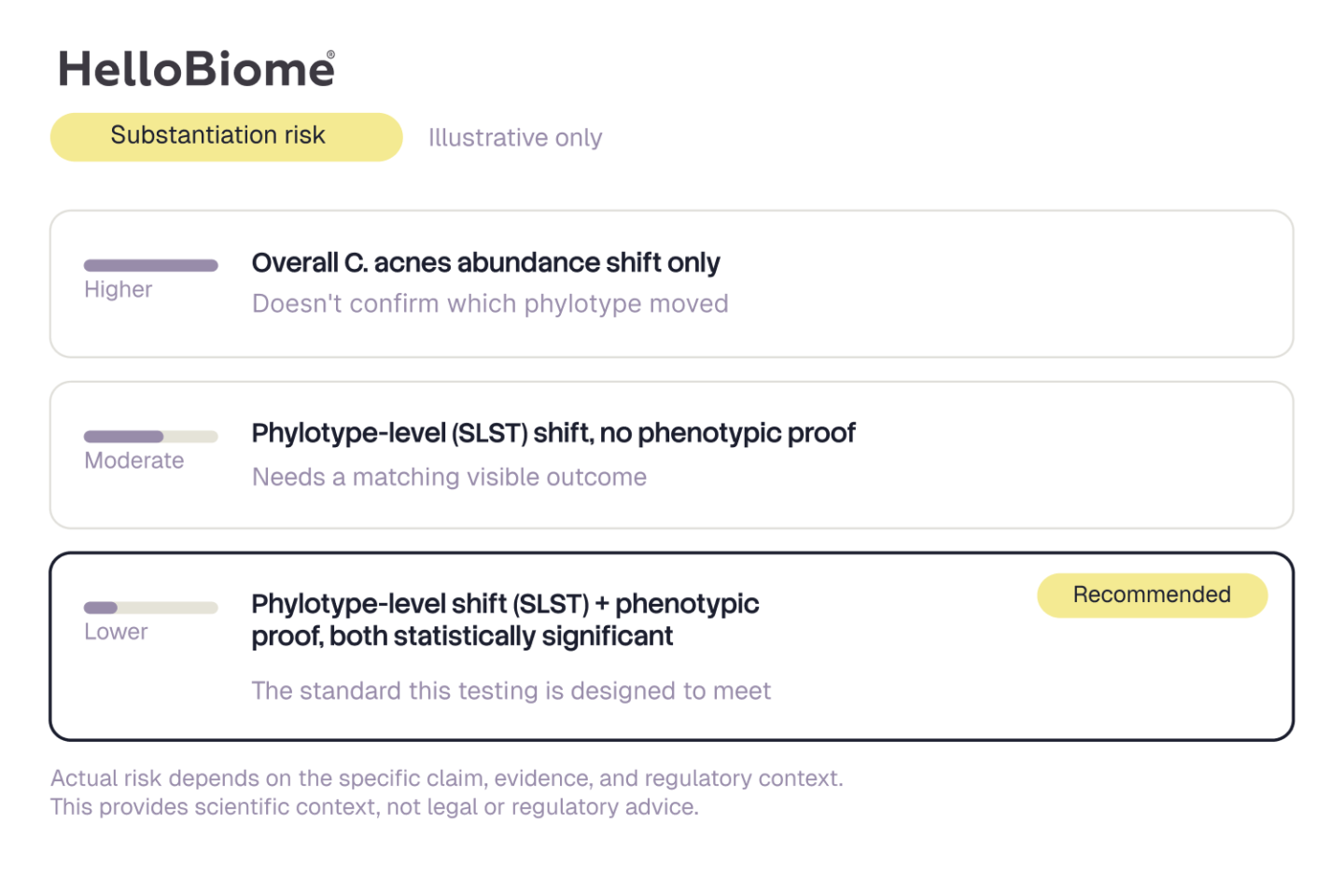
Not every acne or longevity claim needs strain-level data — the right evidence depends on the claim itself. But when a claim points to a specific mechanism (an acne-associated strain declining, a healthy-associated strain increasing), the evidence needs to measure that mechanism directly. That’s why not every layer of evidence carries the same weight:
Beyond Acne: Microbiome Longevity Testing
This resolution matters for longevity claims too. During the session, Elsa and Grace made the same point about aging skin:
We know that with age, C. acnes decreases, and the diversity increases because of that. It’s really important to also look at the SLST level to see that it’s not the acne-related phylotypes that are increasing, but the healthy associated ones.
In other words: a product that reverses the age-related decline in C. acnes only supports a longevity claim if the increase is the healthy-associated kind, not the acne-associated one. Resolving that distinction directly gives longevity claims the same strain-level backing acne claims now have.
Which Test Does Your Claim Need?
Shotgun vs. SLST vs. 16S microbiome testing comes down to one question: what does the claim actually require?
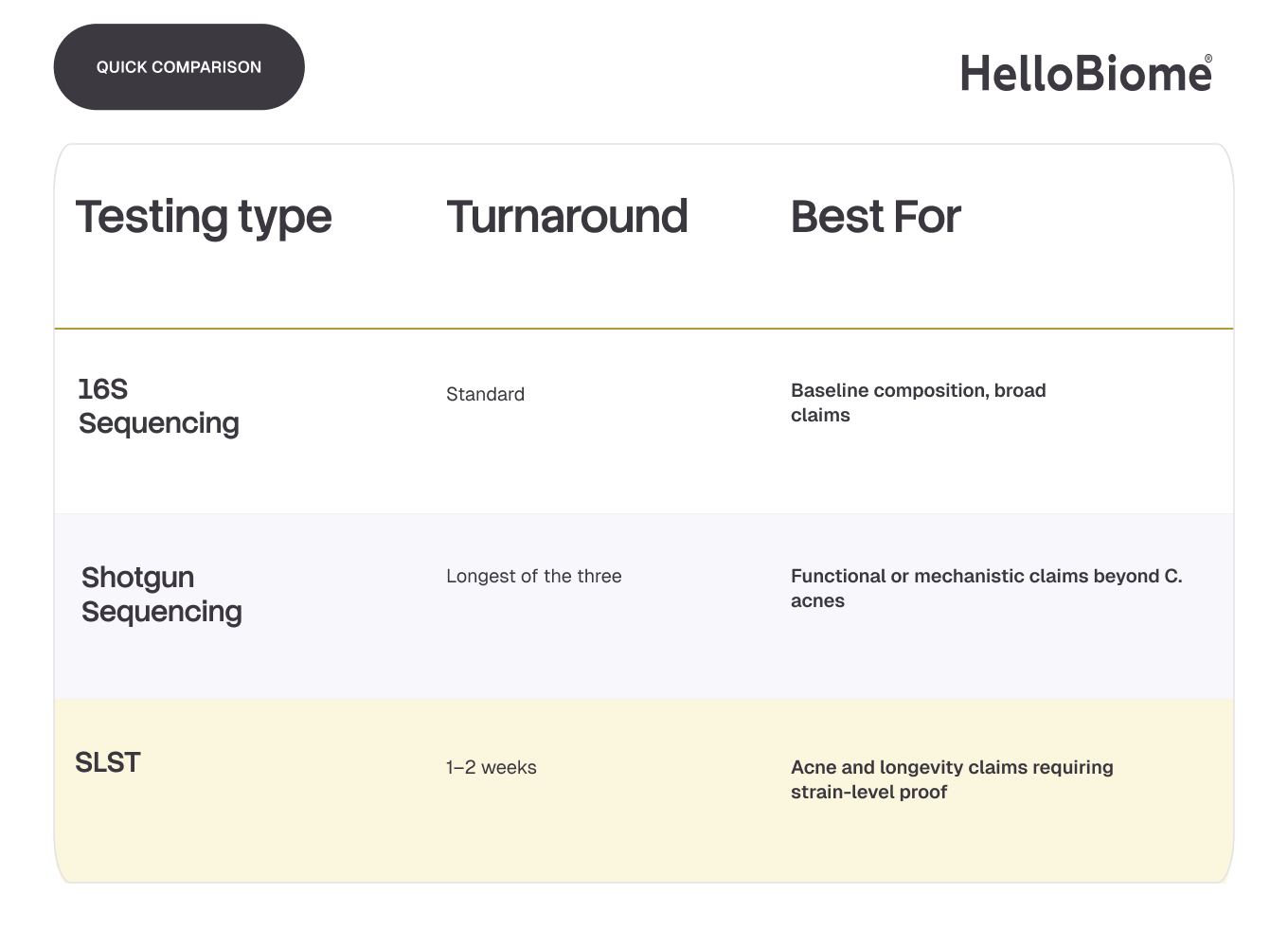
That’s the quick version. The full breakdown — read depth, strain resolution, relative cost, and study-design requirements for each test — is in the comparison chart.
Bringing SLST Into Your Next Study
It’s available now as an add-on within HelloBiome’s Clinical Claims Studies — one swab covers NGS, SLST, or shotgun, stable for a month at room temperature, with freezer storage keeping the option open to add it later. No need to restart sample collection.
Three ways to bring it into your study:
- Add it on top of standard NGS (16S/ITS) — the recommended default, since a claim still needs the overall composition picture NGS provides.
- Run it as a standalone test in narrower cases where strain-level data is the only thing the claim needs.
- Layer it in retroactively on previously banked shotgun samples — no need to redo a past study to add strain-level proof.
Turnaround is as fast as one to two weeks, for both acne and longevity claims.
The right test depends on the acne or longevity claim you’re building — our team can help you determine it.
More to explore
Next up on Microbiome Intelligence Live
A brand can have a claim that’s completely accurate and still lose a class action — not because the science is wrong, but because nobody built the proof before the claim shipped.
During the Microbiome Intelligence Live session on September 17, HelloBiome founder Elsa Jungman, Ph.D., sat down with K&L Gates regulatory attorney Avril Love to walk through exactly what that burden of proof means for a brand’s next claim — and how to build a study that can actually prove it.