

Disclaimer: This article is educational, not legal advice, reflects U.S. law as of September 17, 2026, and shouldn’t be relied on for a specific claim without your own counsel.
A brand can have a claim that’s completely accurate and still lose a class action — not because the science is wrong, but because nobody built the proof before the claim shipped.
Microbiome claims sit at the intersection of marketing and regulatory risk — enforced not just by the FDA and FTC, but by competitors and plaintiff attorneys who scrutinize a claim before a lawsuit even exists.
During the Microbiome Intelligence Live session on September 17, HelloBiome founder Elsa Jungman, Ph.D., sat down with K&L Gates regulatory attorney Avril Love to walk through exactly what that burden of proof means for a brand’s next claim — and how to build a study that can actually prove it.
The Claim That Survives Is a Cosmetic Claim, Not a Drug Claim
Before precision and evidence, there’s a line that determines what kind of claim you’re even allowed to make about products marketed as cosmetics.
“A drug is a product that has an impact on the structure or the function of the body, and a cosmetic is something that enhances the attractiveness and the appearance, potentially, of the user.” — Avril Love, K&L Gates
For a skincare claim, that means staying in the language of “the look and the feel of skin” rather than describing a biological mechanism as if it changes how the body functions.
It’s a narrower line than it sounds. Avril Love later warned that even a well-intentioned microbiome claim can cross it if the causal story is too direct:
“If we do make a direct connection between the microbiome and the benefit in the body, there is a risk that it might become a drug claim”
What the FDA, the FTC, Your Competitors, and Consumer Attorneys Are Actually Looking For
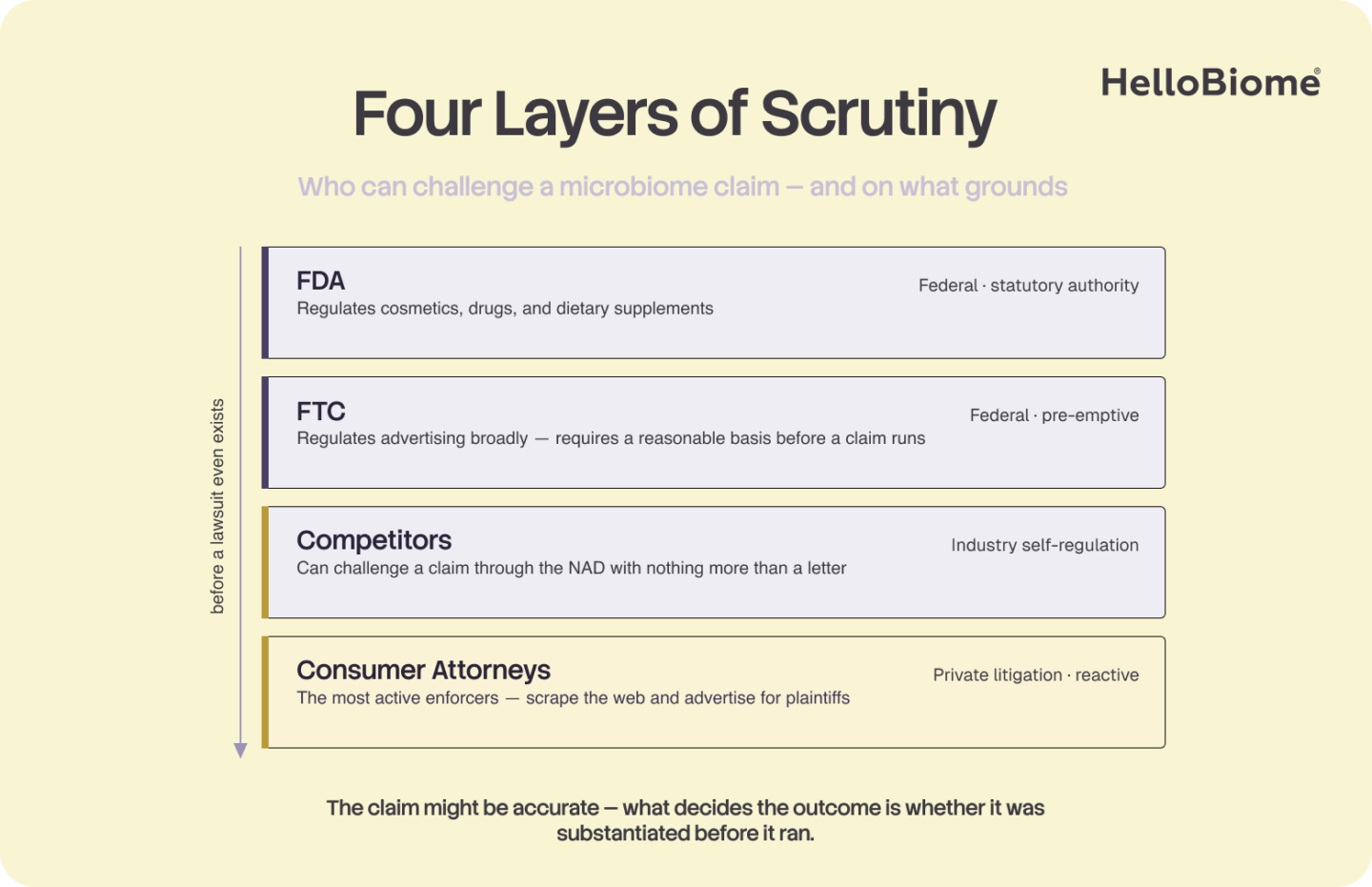
There’s no regulatory definition of “the microbiome,” so your claim will be judged by whether you can prove your product does what consumers expect, and there are four separate parties who’ll ask:
- FDA — regulates cosmetics, drugs, and dietary supplements;
- FTC — regulates all advertising and requires a reasonable basis before a claim runs;
- Competitors — can challenge a claim through the NAD, the ad industry’s self-regulatory body, with nothing more than a letter, shifting the burden to the brand to prove it’s supported;
- Consumer attorneys — not an official regulator, but the most effective real-world enforcer. They scrape the web and advertise for plaintiffs before a lawsuit even exists.
That last layer has real financial teeth: an individual customer’s $17 purchase isn’t worth suing over alone, but a class action changes the math entirely. In a national class, “your real exposure is essentially your gross revenue for the product that they’ve challenged that makes the claim for the last 4 years,” Avril Love pointed out.
Four Layers of Scrutiny
The Claim Comes First — the Study Has to Prove It
Claims substantiation usually starts with whatever a study happens to measure. But a study built without a target claim doesn’t produce a defensible one — it produces data looking for a use.
- A study designed around whatever method is easiest often measures the wrong thing — technically sound, commercially useless;
- Retrofitting a claim onto existing data means settling for whatever the data happens to support, not what the brand intends to claim.
“It’s always going to be the brand’s burden to support whatever claim they make, and you have to support that claim before you make it in the marketplace…. it’s always important, really, to start with the claims… Draft a wish list of the claims that you want, and let’s design studies that will be able to prove those claims.” — Avril Love, K&L Gates
It replaces guesswork with sequence: name the claim first, build the study that proves it — instead of assembling proof after the claim has already shipped.
In Vitro Data Is a Starting Point, Not Proof
The Line Between Screening and Proof
A product can carry a completely accurate in vitro seal and still lack what a cosmetic claim actually needs.
“There’s nothing wrong with an in vitro seal,” Avril Love says, “so long as you also have data that connects what’s happening in the microbiome to a product benefit that’s cosmetic in nature.” Her concern is what it signals without that: “If you use that in vitro seal, it might be a signal that you haven’t done in vivo studies.”
A product can carry a completely accurate in vitro seal and still lack what a cosmetic claim actually needs.
| In Vitro testing | Clinical (In Vivo) testing | |
| What it measures | Ingredient behavior in a dish, under controlled lab conditions | The finished product, on real skin, under real-use conditions |
| Subject | Isolated ingredient or bacterial strain | Human participants |
| What it proves | Biological activity is possible | The claimed effect actually happens |
| Ready to support a claim | Screening signal only | Generally, yes — the evidence the FTC looks for |
The fix isn’t abandoning in vitro work — it’s treating it as a first step, not a last one: inexpensive, useful for screening an ingredient before committing to a longer study, but not a finished-product claim on its own.
Our recent article “Clinical vs. In Vitro Testing: Choosing the Evidence That Supports Your Claim” breaks down how to weigh the two — appropriately designed human clinical studies generally provide stronger substantiation for an objective efficacy claim than lab data alone, per the FTC’s Health Products Compliance Guidance.
Supplier Data Doesn’t Transfer Automatically
That applies to supplier data too. An ingredient supplier’s in vitro seal covers the ingredient, not your finished product, and the gap widens if you use it differently, say a leave-on ingredient in a rinse-off product.
A report showing the ingredient was tested on 17 people may not be enough on its own — it depends on whether the methodology, population, and use conditions match your product. Asked about exactly this scenario, Avril was direct:
“Bridging supplier data to your formulation takes a real scientific analysis someone is willing to stand behind, not an assumption that the data carries over.”
What “Clinically Tested” Has to Mean
The same standard applies to a phrase brands lean on constantly: “clinically tested.” To a plaintiff’s attorney, it has a specific meaning: testing on human subjects, with results measured by instrumentation, not just reported through a survey.
A survey still matters, as it connects that data to what the consumer actually experienced, but it supports the instrumentation, and it doesn’t replace it. It’s the approach behind HelloBiome’s Clinical Claims Studies from day one.
Explore the full breakdown. Access “What ‘Clinically Tested’ Actually Means” — a brochure walking through the definition and what it takes to meet it.
Precision Is What Makes a Claim Hold Up
The more specific a claim is, the harder it is to challenge. A regulator or plaintiff’s attorney can dispute what “sustainable” or “supports the microbiome” actually means — there’s no fixed definition to test the claim against. A claim with a defined boundary doesn’t have that problem.
Precision in the Language
Hand sanitizer claims promising to kill nearly all germs drew a wave of litigation for the same reason: the testing never covered the full range of microbes the claim implied, and the label never said so. The fix is the same in every category — narrow the claim to what was actually tested.
- Vague: “sustainable” → Narrow: “made with renewable bamboo” — “sustainable” has no fixed baseline; naming the material closes that gap.
- Vague: “supports the microbiome” → Narrow: “supports a certain microbe, which is associated with softer skin” — names a mechanism and a benefit instead of leaving both undefined.
Precision in the Proof
Certifications work the same way when the standard behind them is explicit. Avril Love pointed to Sephora’s Clean standard, which survived a real legal challenge because “they’ve done such a good job of defining exactly what their clean standard is, and of communicating it so universally… in their stores, and online…” — not because the standard sounded trustworthy.
The same logic applies to “respects the microbiome”: it’s defensible when “it’s really well defined what you mean when you say that, and that’s well communicated…” — ideally as accessible as “a little QR code on the front” of the package.
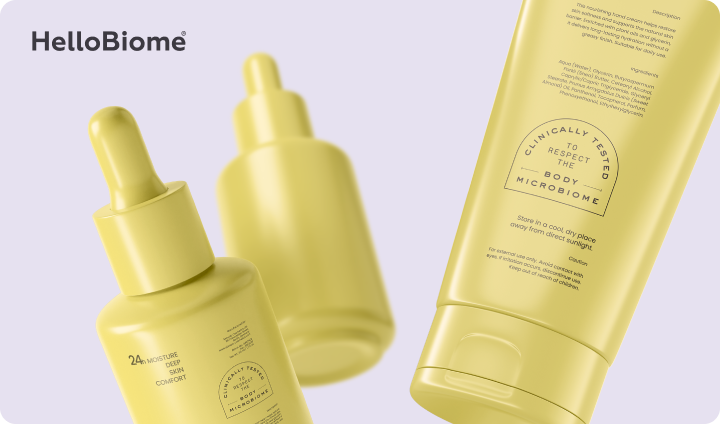
That’s the model behind HelloBiome’s own Microbiome Seal: a defined standard a brand carries on pack, instead of asking a shopper to take the claim on faith.
Bringing This Into Your Next Study
Founders hear this calculus twice: once from regulators and again at the cap table.
“As soon as a brand is acquired, unfortunately, it comes with a certain lawsuit,” Elsa Jungman, Ph.D., noted, “and I know that a lot of acquirers make sure you have the data to back up any claim you’re doing…” — because, as she put it, they want to get ready for “that legal action that may come.”
Clinical Claims Studies are built for exactly that: define the claim set before the study is scoped and share it directly with the study’s designers so the research proves those claims instead of being reverse-engineered from whatever it happens to measure.
The right starting point depends on whether you’re building a new claim or defending one already in the market — our team can help determine it.