

For product and claims teams, the hard part has never been generating microbiome data — it’s turning that data into decisions and claims you can defend.
Microbiome data is inherently complex. It reflects interactions across bacterial and fungal communities, varies by body area, and shifts over time — a complexity widely recognized in microbiome research. That makes it difficult to compare results across study timepoints or translate them into clear, claim-ready conclusions.
To address this, HelloBiome uses three standardized scores that interpret microbiome impact across product development and clinical evaluation:
- Microbiome Balance Score
- Skin Sensitivity Score
- Microbiome Age Score
This article focuses on the Microbiome Balance Score — how it makes microbiome outcomes easy to interpret, and how it supports product decisions and claims. Brands such as OneSkin use it to structure microbiome data for product evaluation and claims.
Interpreting Microbiome Impact in Clinical Studies
By analyzing microbiome data collected after product use, we gain insight into its effect on the skin microbiome.
This approach supports:
-Understanding how a product affects microbiome balance after use
-Comparison of microbiome state before and after application
-Assessment of whether a product maintains or disrupts microbiome stability
-A consistent way to interpret microbiome outcomes across studies
Defining Microbiome Clinical Claims
Microbiome clinical claims are evidence-based statements that describe how a product interacts with and affects the skin microbiome. These claims must be supported by biological data demonstrating measurable changes or stability in microbial balance or diversity under product use conditions.
The Microbiome Balance Score: Turning Complexity Into Clarity
The Microbiome Balance Score translates complex data into a standardized indicator of microbiome state.
In most studies, the score does not change significantly — and that stability is itself an important result. The value of the score is not in showing change, but in making that outcome easy to interpret and compare.
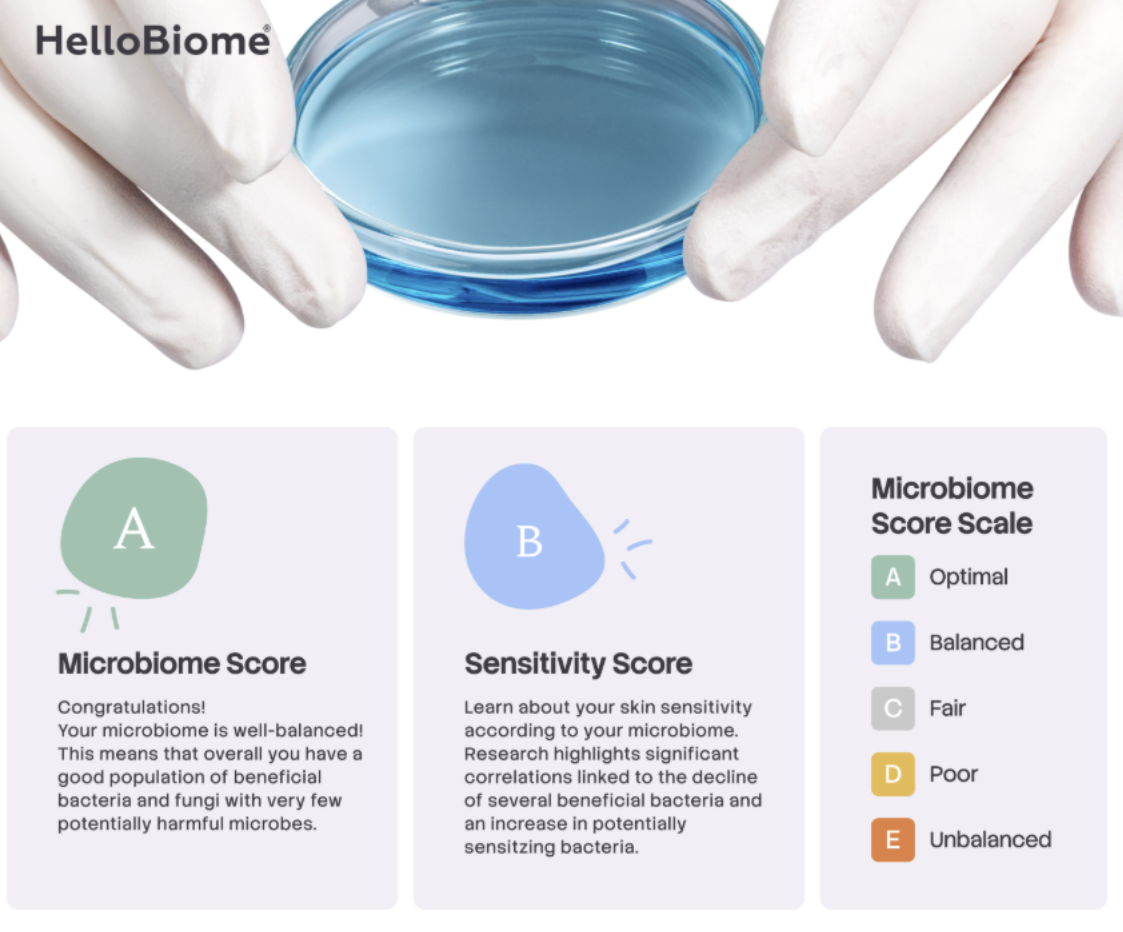
The Microbiome Balance Score reflects:
A – Well‑balanced microbiome
B – Balanced
C – Slight imbalance
D – Imbalanced
E – Strong imbalance
Scores are based on a comprehensive skin microbiome analysis of both bacterial and fungal communities, measured across specific body areas. This provides a consistent interpretive layer for teams to understand and communicate microbiome outcomes across studies.
From Results to Claims Development
Without a standardized way to interpret results of cosmetic clinical claims testing, teams lack a method to determine how biological changes support compliant claims.
The Microbiome Balance Score framework helps teams interpret biological results in a way that supports claims:
-When a product maintains its score, it indicates microbiome stability under product use;
-When a product improves its score, it suggests a shift toward improved microbiome balance.
The score does not replace biological analysis — it provides a consistent way to translate and communicate microbiome outcomes.
This ensures that marketing and product storytelling are grounded on claim-ready microbiome evidence that is provided consistently across scientific, regulatory, and commercial stakeholders. More practical insights are outlined in the clinical evaluation of the OS‑01 Face formulation by OneSkin.
Product-Level Microbiome Impact
Rather than working directly with complex datasets each time, teams can rely on the Microbiome Balance Score to understand microbiome state across study timepoints.
This enables:
-Comparing microbiome outcomes before and after product use
-Understanding overall product impact on the microbiome
-Identifying whether a product maintains or disrupts microbiome balance
The Microbiome Balance Score is not used to evaluate or optimize formulations, but to provide a consistent way to assess overall product impact on the microbiome in clinical studies.
Translating Data Into Claim-Ready Evidence
Strong product claims depend on how microbiome data is interpreted and applied. As a result, formulation and claims are based on consistently interpreted microbiome insights rather than assumptions.
Learn more about HelloBiome’s Clinical Claims Studies and how standardized microbiome scoring supports clinical interpretation of microbiome impact.
Additional scores, including Skin Sensitivity and Microbiome Age, provide further context on microbiome impact and will be explored in future articles.